
Regulation vs. Law
What's the difference?

In the backyard of an Airbnb where I stayed, an orange tree grew on the neighbour’s side, with ripe fruit hanging over the fence. Who has the right to harvest that overhanging fruit—the owner of the Airbnb house, the neighbour, or the Airbnb guest (me)?
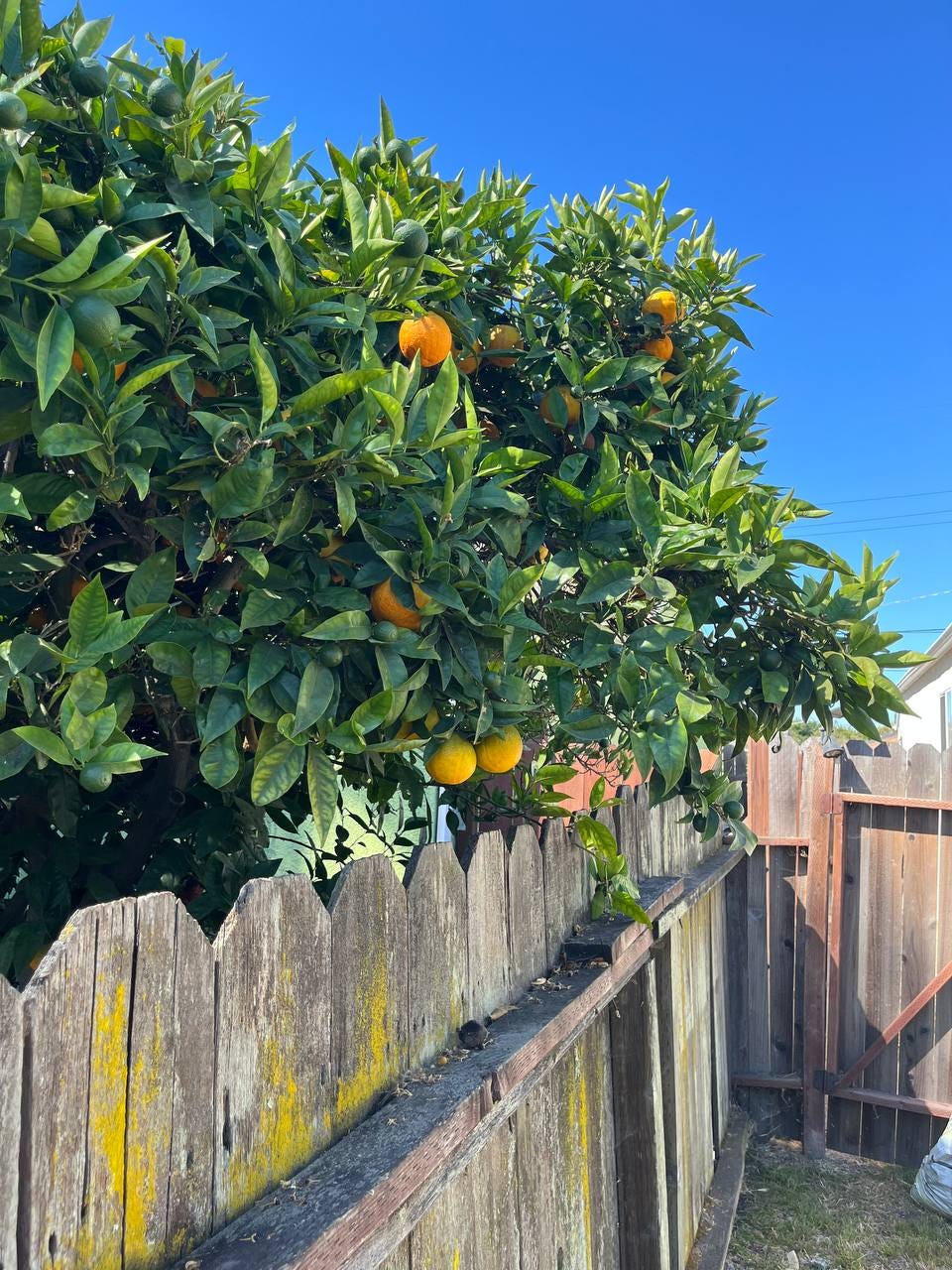
The house’s backyard also had a neglected plum tree—neglected because many ripe plums had fallen, rotting on the ground and creating an unpleasant sight. Apparently, the owner of the Airbnb rarely visits to pick them. Does the Airbnb guest have an ethical right to eat the ripe plums that haven’t yet fallen?
As you can see, from the perspective of private property, this situation raises a host of questions to ponder. If we let the government rein in with its swashbuckling regulations, it would likely either forbid trees from being planted close to the fence or require the neighbour (the owner of the tree) to regularly trim it—threatening fines if he doesn’t. The first would limit usable space in already small backyards, while the second would result in a tree that has fewer fruits, is less beautiful, and requires more work to maintain (resulting in less trees being planted).
Isn’t it better if the “victim” house owner—who has fruit hanging onto his yard—enjoys some free oranges? That’s what would happen in the absence of regulations, but with laws in place. If the house owner finds it damaging that the tree overhangs into his yard, he can ask the neighbour to trim it or sue if the neighbour refuses. However, if he enjoys the opportunity to reap an orange, he can simply let it be.
Capitalism promotes win-win arrangements; statism is lose-lose. Laws allow a victim to sue a perpetrator after the deed has occurred. In contrast, regulations prevent things from happening in the first place, putting barriers in front of creative solutions. They stifle innovation and force entrepreneurs to seek better pastures.
It’s time to repeal all regulations. Unlike repealing taxes or social security, which would require a long process of adjustment, regulations can be repealed in one big swoop by a single signature. To some extent, Milei has done this in Argentina, canceling whole government departments which regulated many aspects of people’s lives. In one year, he cut 30% of government spending and 9% of government staff. This happened because Argentina was on the brink of bankruptcy, and the population went along with radical changes—even though a quarter million government workers lost their jobs. Yet Argentina—a country of great weather and natural resources—has repeatedly descended from glimpses of prosperity into abject poverty of statism.
Will Milei’s changes stick, or will the country swing back to statism the moment that the disaster is averted? And what about the remaining 70% of regulations — when will they be repealed? How long are you prepared to wait it out, dear reader, to gain freedom from regulations? Can you wait for a century or two? Remember that the Dark Ages lasted for half a millennium.
Instead, the Go Anthem initiative adopts a different approach: building from the ground up in a semi-deserted territory. By establishing a constitution and a system of checks and balances, it seeks to ensure that statism never takes hold in a first place.
I like your metaphor. And I agree that I should be able to plant whatever I want on my property. I live in a HoA, so this is especially relevant to me.
I'm not fully on board that "all" regulations should be eliminated. I agree that regulations have costs. And I see many regulations as bad policies that restrict innovation and personal freedom. I'll have to think about this more. I'm not really afraid of companies selling poison because people don't want to buy poison. And companies selling poison will have a difficult time staying in business for the same reason.
What would be some of your least bad regulations? If you had to keep a few, which would you keep?